Explore the research record behind the technology foundation.
The publication library connects project development with peer-reviewed research, theses and other verified uses of Brinter technology.
Explore evidence →ESA 3D-BioSystem development initiated in 2024.
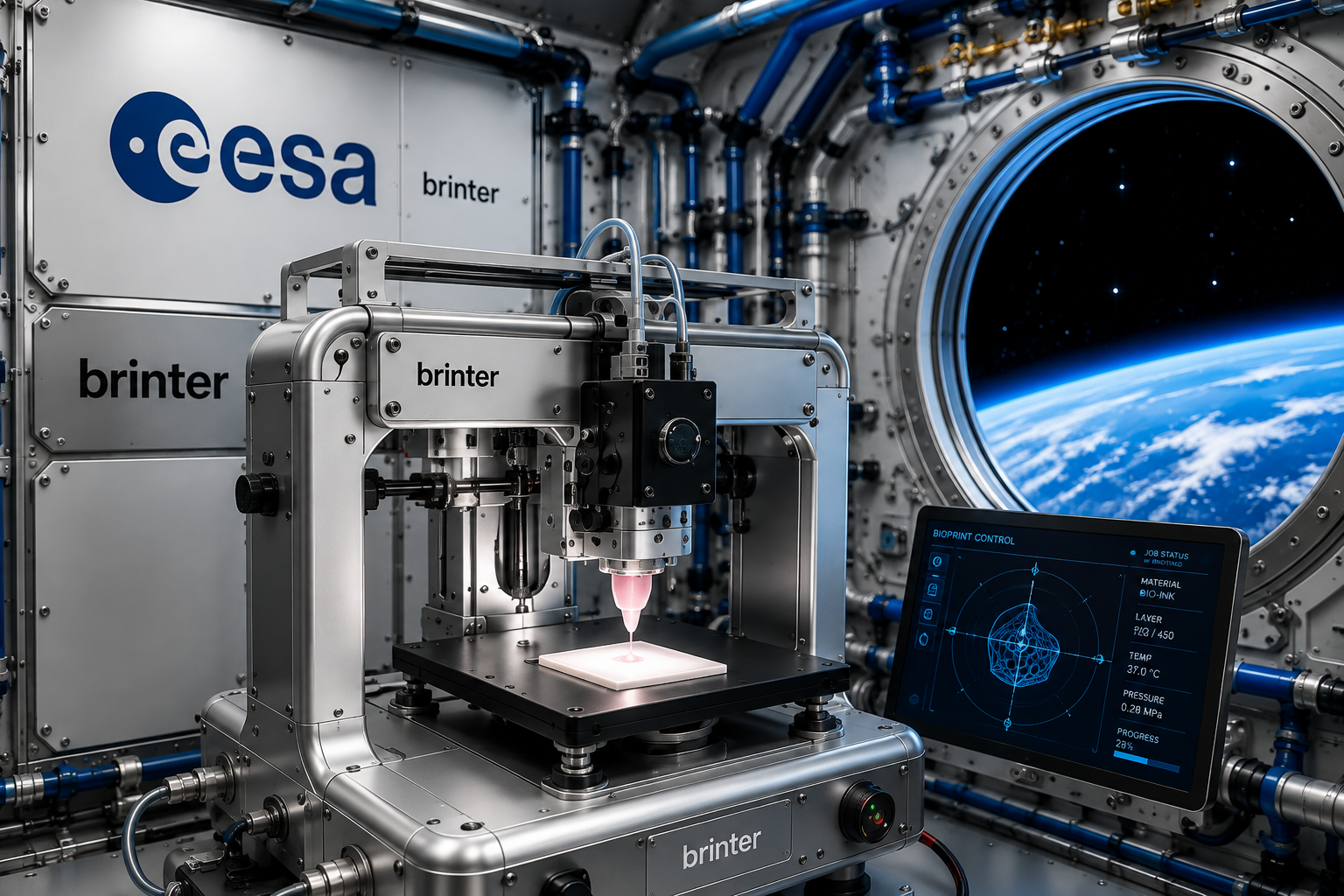
Brinter AM Technologies Oy worked with Redwire Space NV under an ESA programme focused on the design and development of the 3D-BioSystem concept for research in microgravity environments.
The development work focused on adapting the Brinter Core technology toward the demanding technical, safety and operational requirements associated with in-orbit use and an ISS-class environment, with the goal of enabling the generation of 3D biological samples in microgravity.
The originally planned deployment of the system to the International Space Station did not proceed as initially envisioned, but the project remains an important example of how Brinter technology can be engineered toward highly constrained space and microgravity applications.
Microgravity creates a distinct environment for 3D bioprinting. Cells can grow and assemble without the same gravitational constraints present on Earth, and printed structures do not need to support their own weight in the same way during formation and maturation.
The development explored how 3D bioprinting and subsequent cultivation in microgravity could support research involving cell constructs, organoids, tissue explants and 3D cell matrices, while helping scientists better understand the bioengineering and biofabrication requirements of viable and functional tissues.
Space applications impose demanding requirements on size, reliability, process control, safety and system integration. Spaceflight hardware must also be developed within exceptionally strict qualification, verification and documentation frameworks, where failure tolerance is low and the operating environment places unusual constraints on materials, interfaces and system behaviour.
In many respects, this makes space one of the most demanding environments for technology development and qualification — comparable to, and in some areas even more restrictive than, regulated medical applications. Working toward these requirements strengthens engineering disciplines that are directly valuable in other high-consequence fields, including medical and advanced manufacturing.
The project illustrates how a modular research platform can be adapted toward a highly application-specific manufacturing environment while preserving the core technology foundation.
A 2026 peer-reviewed study in Advanced Materials Technologies used Brinter Core during a parabolic-flight campaign as a representative prototype for the 3D-BioSystem concept. The printer was integrated into a self-contained flight rack and successfully produced cell-laden constructs during repeated microgravity phases aboard the Airbus A310 ZERO-G.
The study evaluated a practical supply-chain challenge for future space bioprinting: how to deliver functional cell-laden bioinks to a crewed space platform without relying on full cell-culture infrastructure at the destination. Cells transported separately as cryopreserved vials were mixed with an acellular biomaterial ink shortly before printing. After 40 days of post-flight cultivation, this cryo-based workflow achieved cell viabilities above 90%, comparable to the freshly prepared reference bioink, while the two-week cold-stored premixed bioink showed no detectable viable cells at the final time point.
For BrinterAM, the work provides an important continuation of the original 3D-BioSystem development: it demonstrates the platform operating in a demanding microgravity environment and highlights how manufacturing technology, material handling, process control and logistics must be engineered together for real-world space biofabrication.
The publication library connects project development with peer-reviewed research, theses and other verified uses of Brinter technology.
Explore evidence →The original 3D-BioSystem development is complemented by later peer-reviewed microgravity research using Brinter Core as a representative prototype. Explore the publication and project background below.
Back to projects →