Explore the research record behind the technology foundation.
The publication library connects project development with peer-reviewed research, theses and other verified uses of Brinter technology.
Explore evidence →Developing a controlled multi-process platform for full-thickness, native-like corneal grafts.
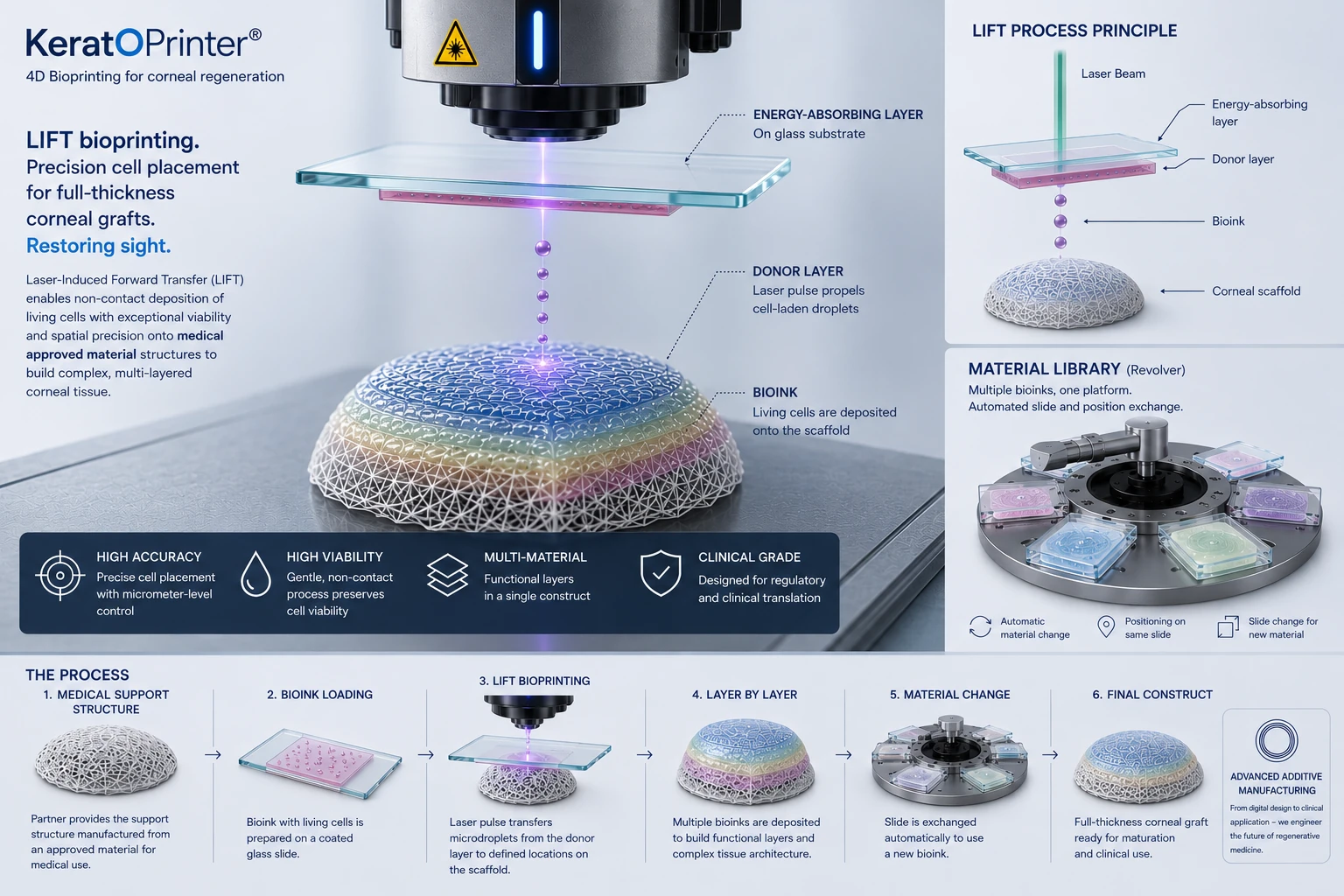
KeratOPrinter brings together an engineered support structure, cell-laden bioinks and laser-assisted bioprinting to develop full-thickness corneal grafts.
The manufacturing sequence combines multiple process steps and materials in one controlled workflow, from the supporting structure and bioink loading to precise layer-by-layer deposition and material exchange.
AM Technologies by Brinter contributes the manufacturing technology and system integration needed to bring the specialised process steps into a common platform architecture.
The work includes integration of laser-assisted deposition and multi-material processing so the manufacturing platform can support precise, repeatable handling of the different functional layers required by the application.
KeratOPrinter is a strong example of application-driven manufacturing development: the biological objective defines the process, the process defines the platform, and repeatability, material handling and future translation requirements are considered as the system matures.
A 2026 Tampere University master's thesis conducted within the KeratOPrinter project used the laser bioprinting prototype developed by AM Technologies by Brinter to study key BA-LIFT process parameters. The work examined how laser pulse energy, polyimide energy-absorbing layer thickness and bioink viscosity influence blister formation and droplet transfer.
The results showed that thicker polyimide layers tolerated higher laser pulse energies before blister rupture, while bioink composition and rheological behaviour had a major influence on successful droplet transfer. The study provides practical process-development evidence for further optimisation of the KeratOPrinter laser-assisted bioprinting platform.
The publication library connects project development with peer-reviewed research, theses and other verified uses of Brinter technology.
Explore evidence →Read more about the European project and explore selected research outputs and current project activity through the links below.
Back to projects →